

What if God is leading you somewhere you never expected to go?
Few experiences are more unsettling for a Christian than the feeling that God has become distant. You pray, read Scripture, attend church, and try to stay faithful, yet the warmth and certainty you once felt seem to disappear. When that happens, many of us assume we’ve done something wrong. We begin searching for the mistake, wondering why God feels absent and how we can get back to where we used to be.
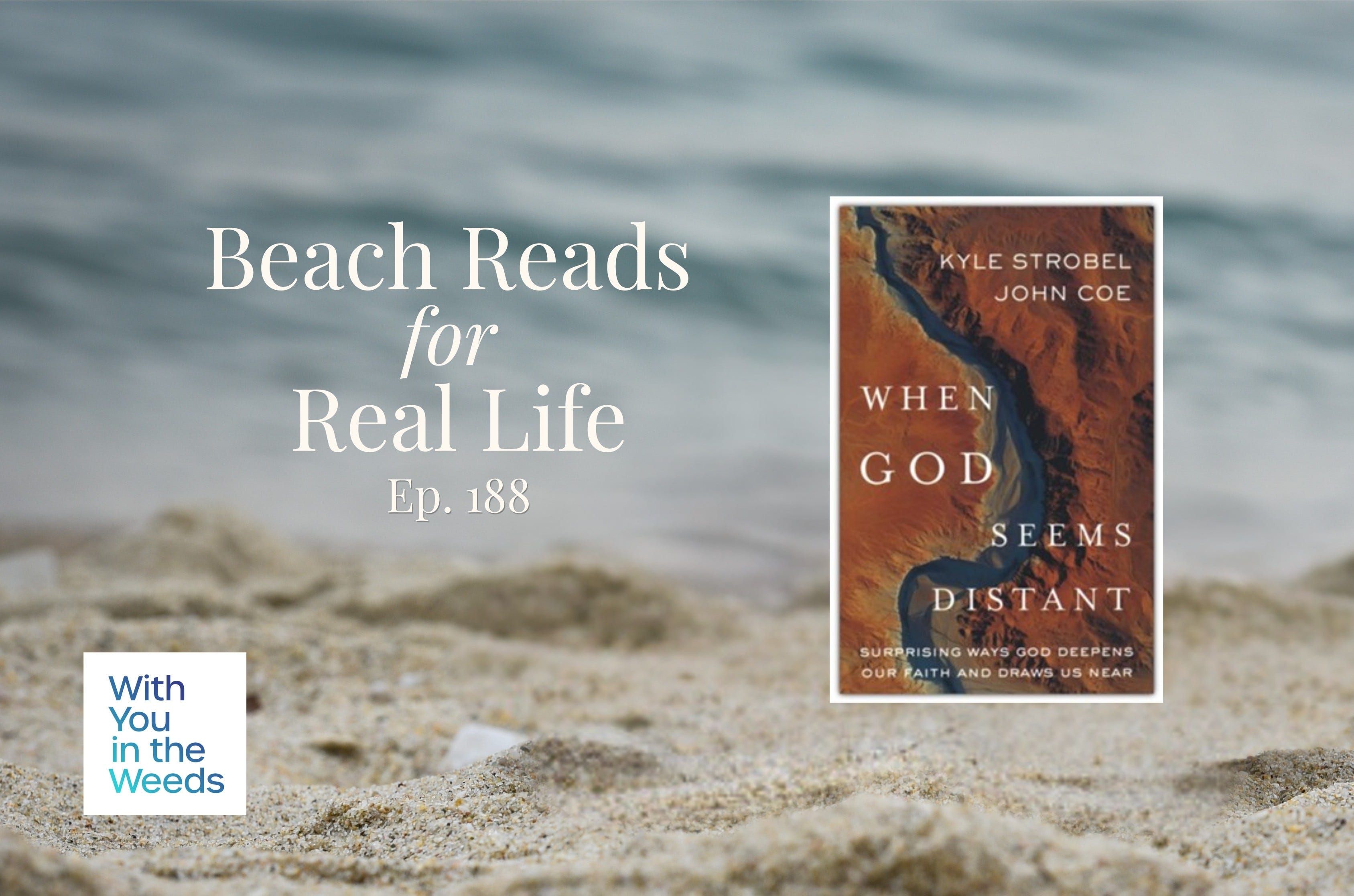
In the first episode of our short summer series, Beach Reads for Real Life, listen in as John talks about the book When God Seems Distant: Surprising Ways God Deepens Our Faith and Draws Us Near by Kyle Strobel & John Coe. The authors challenge the assumption that the Christian life should be a steady climb from one spiritual high to the next. Instead, they show how God often does some of his deepest work in seasons of uncertainty, silence, and longing.
What makes this book so refreshing is its honesty. Rather than offering quick fixes or formulas for getting God back, the authors identify feelings that many believers experience but rarely discuss. They invite you to stop treating your spiritual life like a self-improvement project and begin seeing it as a relationship that grows through vulnerability, dependence, and surrender. If you’ve had times in your life when God feels far away, this book offers both comfort and a different way of understanding the journey.
Highlights from this Episode
Have you ever felt spiritually dry—and wondered if you were the problem?
Mother Teresa went for some 38 years without feeling the presence of Jesus. She talked with her spiritual advisors and wrote very often about this in her personal journal entries. Here is one journal entry from 1959:
That darkness that surrounds me on all sides — I can’t lift my soul to God — no light or inspiration enters my soul.
She wrote of feeling like a hypocrite and the Roman Catholic church hesitated to publish her personal journals because her expressions of the pain from not feeling Jesus’ love for her were very clear…but she persevered in her faith without feeling close to God.
Among Christians, this kind of painful honesty is rare. We may be afraid to share that we are going through a season of spiritual dryness because we fear what others may think. But this sense of “dryness, wilderness, or spiritual darkness” is something I’ve heard from many of my clients over the years. It’s more common that we realize—and it can be confusing for a Christian.
Perhaps you’ve struggled with this in some form. For example, it’s common to start out as a Christian with excitement and new energy, only to have the experience of it fade. Reading the Bible becomes boring, prayers become empty rehearsals, and so many things are more exciting than spending time with God. You may end up feeling like a spiritual weakling or failure.
The book When God Seems Distant addresses this issue by revealing how spiritual dryness deepens intimacy with God and renews your soul. This book doesn’t offer escapism like a traditional “beach read” does, but presents a very thoughtful map through times when God does not seem or feel present.
If you go to the beach and feel like your Christian faith is lacking, then this book is definitely a “beach read”. I would heartily recommend it as a resource to turn to again and again when spiritual things are flat or God seems nowhere to be found in your life. The authors’ recommendation for dealing with spiritual emptiness may surprise you.
Understanding the Spiritual Desert
What’s the first thing you instinctively think when you feel spiritually dry? You may assume that your spiritual dryness is because of your own personal failure or God withdrawing from you as punishment. In response, you may double down on studying spiritual disciplines and serve more in order to muscle your way back…or engage in self-rejection and get lost in shame.
The book’s core correction to this response is to understand that dry seasons are not evidence of failure—they are part of God’s plan to draw us into a deeper walk with him. Willpower and habit modification cannot fix the spiritual life, because that entirely misses the point of the wilderness.
The authors suggest that God’s movement in our lives takes us into hard places where we learn to rely upon a faith that is sometimes unseen. This gives a nod to the Apostle Paul’s teaching to “walk by faith, not by sight”.
Seasons of the Soul
Have you ever thought of the Christian life as seasons? We repeat these three seasons, in various intensities, throughout our lives:
Consolation: Feeling God’s nearness and warmth; the spiritual “honeymoon.”
Desert: Dryness and distance; God feels absent but there is no particular spiritual darkness.
Desolation: Deeper darkness, disorientation, even the feeling of abandonment.
As Moses cautions the Israelites in Deuteronomy 8:2, “Remember how the Lord your God led you all the way in the wilderness these forty years, to humble and test you in order to know what was in your heart, whether or not you would keep his commands.”
God uses these seasons to reveal what’s in our hearts and wean us off needing the feeling of his presence as the basis of faith. When God seems distant, you are not behind. You are not failing. You may be in exactly the right place.
The Sneaky Way We Try to Control God
Can you relate to trying to “fix” your spiritual life the way you’d fix a productivity problem? Self-willed spirituality makes us think we’re drawing near to God when we are actually managing and manipulating him. We may use spiritual formation, disciplines, ministry, or moral behavior to relieve the burden of failure—trying to do in the flesh what only Christ can do.
We may use spiritual formation, disciplines, ministry, or moral behavior to relieve the burden of failure—trying to do in the flesh what only Christ can do.
The authors discuss two ways we try to come back to God after sin:
When convicted of sin, the first response is “I’ll do better” using your own efforts rather than seeking Christ.
Instead of bringing failure to God, you cover it through self-rejection rather than uncovering it to the Lord.
The church’s emphasis on spiritual disciplines, while good, has drifted toward an “input/output spirituality”: if you do the right things, you will get the right results. Conflating the Spirit’s work with our own spiritual practices is one of the main mistakes of the Christian journey.
Purpose in the Wilderness
Here’s what God is actually doing during dry spiritual seasons. He is testing your faith and giving you a chance to choose to rely on him even when the “feelings” aren’t there. Picture the Israelites wandering in the wilderness or Jesus fasting in the desert. Scripture shows that God’s people are consistently baffled by how he chooses to lead them through hard times rather than around them—and that’s by design.
God leads us into the wilderness to humble, test, and reveal what is truly in our hearts. God is not absent in the desert. He is working. The question is whether you’ll trust God when you cannot feel him. It’s important to remember: The desert is not a detour. It is the path.
Practical Wisdom for Seasons of Absence
Stop trying to engineer consolation. Don’t manufacture a spiritual experience to escape the discomfort. Sit with the season.
Be honest and practice lament. Honesty and lament are not signs of weak belief—they are the very path into deeper encounter with God. Bring what’s real, not what you think you’re supposed to feel.
Don’t go it alone. The book emphasizes the necessity of guidance and community in difficult seasons: join a small group, find a mentor, or talk with a Christian therapist or trusted friend.
Resist the moralistic reflex. When you feel the pull to “just do better,” pause. Ask: Am I seeking God, or am I trying to fix myself?
Inquire rather than escape. The call isn’t to get out of desolation, but to ask: Lord, what does it look like to be faithful and obedient right here, right now?
Relearn being loved. The final call of the book is not to perform better but to receive—to relearn loving God and being loved by him. This requires the very vulnerability the desert creates.
The wilderness is not where most of us would choose to meet God, yet Scripture and Christian history repeatedly show that it is one of his favorite places to form his people. If you’re walking through a season where God seems distant, this book offers a hopeful reminder: your spiritual dryness does not have the final word.
Rather than seeing these seasons as proof that something is wrong, you may begin to recognize them as invitations into a deeper, more resilient faith. When God Seems Distant provides wisdom, perspective, and encouragement for learning how to trust God’s presence even when you cannot feel it—and that may be one of the most important lessons of the Christian life.
Recommended Resource
When God Seems Distant: Surprising Ways God Deepens Our Faith and Draws Us Near by Kyle Strobel and John Coe
I'm so glad it was helpful. Praise God!