

Have you ever wondered if your body knows something that your mind hasn’t caught up to yet?
Maybe you’ve always thought of stress as an emotional experience; something that affects your mood, your thoughts, or your relationships. But what if stress has a profound effect on your body? And what if that stress started when you felt like you couldn’t say no?
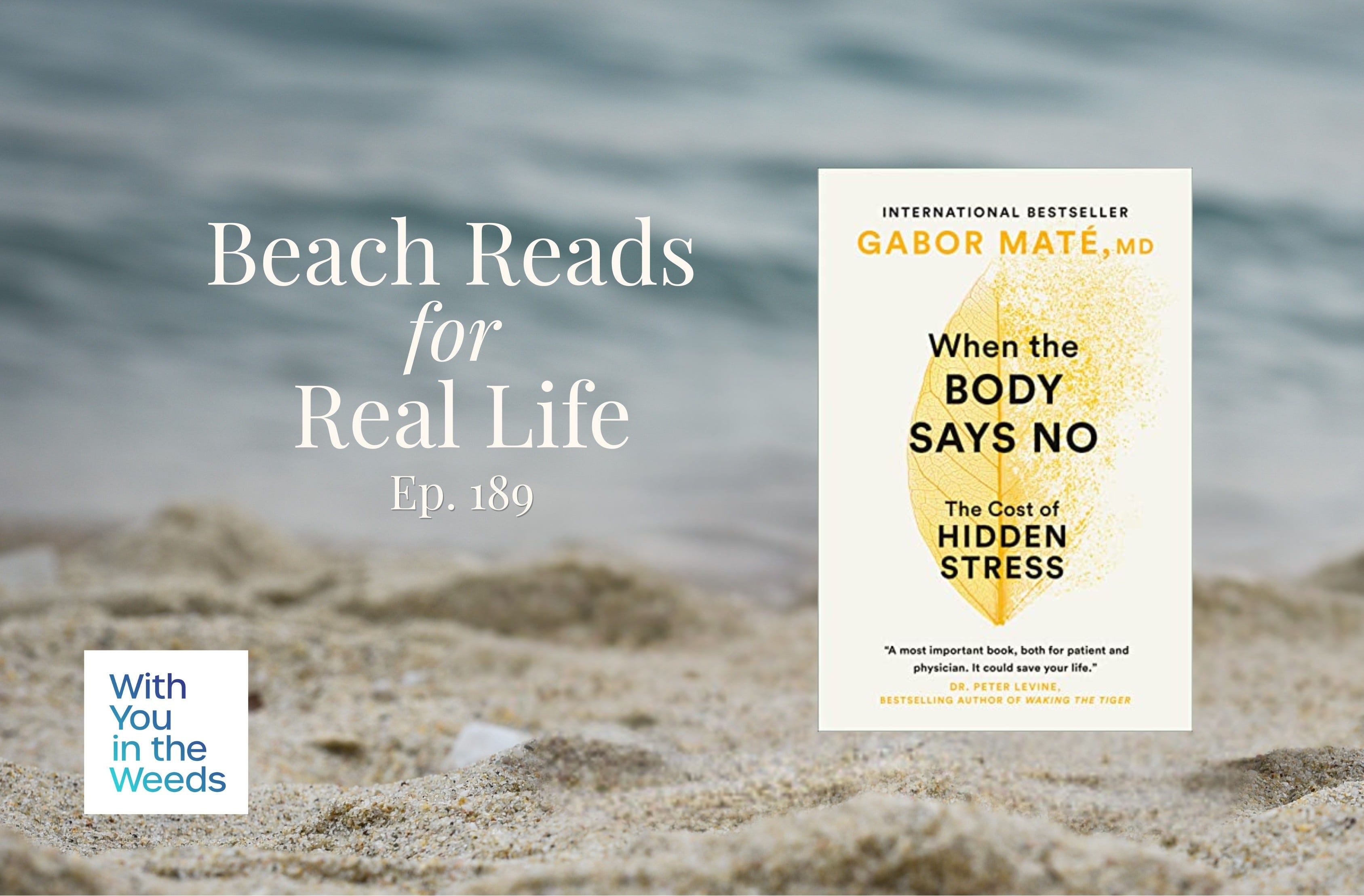
In this next episode of our summer series, Beach Reads for Real Life, Lynn explores a fascinating and sometimes controversial question posed by the book When the Body Says No: The Cost of Hidden Stress by Gabor Maté. What happens when the need to be loved, accepted, or needed becomes so important that we lose touch with our own limits?
You’ll be challenged to consider the ways your life experiences, coping strategies, and emotional patterns have shaped your physical health. At the same time, Christians need a framework that goes beyond psychology alone. Scripture reminds us that not all suffering is a problem to solve. Some suffering comes from faithfulness, sacrifice, and obedience to Christ.
Listen in as Lynn examines where Maté’s insights are helpful, where they may fall short, and how the gospel speaks to our deepest need for love, connection, and healing. You’ll discover that when your life is in God’s hands, you are free to be honest about your wounds because your worth is already secure in Christ.
Highlights from This Episode
I was drawn to this book because I am very interested in understanding the connection between stress and disease in our bodies. As a 51-year-old woman who went through menopause at the early age of 40, and as someone who has walked through cancer and autoimmune diagnoses with several friends, I want to become aware of how hidden stress may be impacting my health.
Maté spent decades in family medicine and palliative care and noticed a pattern he couldn’t ignore. Many patients facing devastating diagnoses were remarkably kind, self-sacrificing, and reluctant to complain. He became curious about the connection between emotional patterns and physical illness, and this book is the result of that exploration.
I’ll break this episode into two parts. First, we’ll look at four core principles from the book. Then we’ll evaluate those ideas through the lens of Scripture, because while I think Maté gets a lot right, I also think his framework has limits.
Trading Yourself for Connection
Let’s start at the beginning. Do you remember the first time your body said no? Probably not. But from the moment you were born, your body was communicating your needs. Before you had words, it signaled when you were hungry, tired, frightened, frustrated, or in distress. Eventually, many of us learned to say “no” with our words, not just our bodies.
But what happens when a child’s no is upsetting to their caregiver? Every child needs limits, but if your family environment was uncomfortable with your thoughts, feelings, needs, or individuality—and if you never felt permission to say no and still be loved—you may carry that pattern into adulthood. Maté argues that when we learn to suppress ourselves in order to maintain connection, our bodies may eventually begin saying no for us.
Maté postulates that when we subconsciously learn the protective mechanism of repressing our feelings in order to keep connection with our parents, and we forfeit our ability to say no when we can or should, our bodies may end up saying it for us. In his practice as a medical coordinator of the palliative care unit at Vancouver Hospital, he found that almost none of his patients with a serious disease had learned to say no as an adult.
He observed that when children learn to subjugate their own wants or needs for the sake of maintaining connection with a parent, that that is the precursor for many autoimmune diseases, including MS, chronic fatigue syndrome, autoimmune disorders, migraines, endometriosis, and other conditions.
The Hidden Cost of Being Nice
Here are 4 principles that will help you understand your mind/body connection:
Principle #1: Your body and your emotions are not separate systems. Maté argues that Western medicine often treats the body and mind as separate systems. But the field of psychoneuroimmunology suggests that distinction is artificial. Your nervous system, immune system, hormones, and emotional life function as an interconnected whole. Chronic stress can influence inflammation, immune function, and disease processes throughout the body.
Principle #2: Overriding your emotions teaches your nervous system that connection is more important than authenticity. Maté calls this emotional repression. It’s rarely a conscious choice. In childhood, we learn that certain emotions feel unsafe—that anger isn’t welcome, sadness is too much, or our needs make others uncomfortable. So we adapt. We become easygoing, compliant, and self-sufficient because maintaining connection feels essential for survival.
The problem is that difficult emotions don’t simply disappear. According to Maté, they often show up later through stress-related symptoms, fueled by an erroneous set of beliefs that run in the background and shape our feelings and decisions:
Belief #1: “I have to be strong.” The only safe posture is being constantly capable.
Belief #2: “It’s not right for me to be angry.” It turns inward and becomes self-criticism.
Belief #3: “I’m responsible for the whole world.” You feel the need to fix things for everyone.
Belief #4: “I should be able to handle anything.” Asking for help feels like weakness.
Belief #5: “I must justify my existence.” Your worth has to be earned.
Principle #3: The nicest people get the diagnosis. Maté noticed a common profile among many patients with autoimmune disease, chronic fatigue, migraines, and certain cancers. They were often caretakers, people-pleasers, and highly responsible individuals who struggled to acknowledge their own needs.
While these patterns often show up in women, men are frequently taught that emotional stoicism is strength and vulnerability is weakness. Chronic stress affects both sexes, contributing to cardiovascular disease, digestive issues, sleep disruption, and other health problems over time.
Principle #4: Your symptoms are questions that your body is trying to ask. Most people seeking counseling are looking for symptom reduction. They want to feel less sad, less anxious, less depressed, less angry, less upset. But Maté reframes symptoms. They’re not malfunctions that need to be silenced, they’re communications that need to be heard. He encourages questions like: Where have I been overriding myself? What am I afraid would happen if I fully expressed my feelings? Why is my body saying no?
Looking at Maté Through a Biblical Lens
I recently returned from a trip retracing parts of Paul’s missionary journeys, including a visit to the Mamertine prison where he was likely held before his execution. Standing in that dark, cold, underground prison cell, history suddenly felt very real. And it highlighted where Maté’s framework and the biblical framework must be held in tension.
Paul did not end up in prison because he lacked boundaries, ignored unresolved emotions, or failed to listen to his body. He suffered because he was faithfully following Christ. If Paul only listened to his body, he could have abandoned his mission and preserved his life. Yet his priorities had changed completely after his encounter with Jesus. In the book of Philippians, a letter that he wrote from captivity, he says:
Now I want you to know, brothers and sisters, that what has happened to me has actually served to advance the gospel. As a result, it has become clear throughout the whole palace guard and to everyone else that I am in chains for Christ. And because of my chains, most of the brothers and sisters have become confident in the Lord and dare all the more to proclaim the gospel without fear.
For to me, to live is Christ and to die is gain.
Paul saying yes to God came at great sacrifice emotionally, mentally, and physically. Here’s where I hesitate to wholeheartedly embrace Maté’s message because there is an interpretation of it that implies that if you are sick or suffering, it’s because your parents didn’t let you express your emotions. Or if you have an autoimmune disease, it is because you said yes when you should have said no.
While I think there is real truth in some of the patterns that he describes, if we take that to its logical extreme, there’s no room for Paul to be in that Roman prison, let alone for Christ to empty himself out as an offering because of his great love for us. There’s no room for anyone who has ever suffered, not because they abandoned their emotions, but because they were faithful and obedient to Christ.
There is a difference between suffering that you endure because of faithfulness to Christ and suffering you endure because you were taught that you could never say no. The suffering that Paul describes is not a symptom. It is a calling. Paul doesn’t want the Philippian church to lose heart over his suffering, because it is meaningful.
There is a difference between suffering that you endure because of faithfulness to Christ and suffering you endure because you were taught that you could never say no. The suffering that Paul describes is not a symptom. It is a calling. Paul doesn’t want the Philippian church to lose heart over his suffering, because it is meaningful.
God’s unconditional love received over and over, not just believed as a doctrine, but felt in our souls and in our bodies, speaks to the nervous system’s deepest desire to be known and to be loved. Maté can name the wound, but the gospel can heal it because being connected to Christ is your protection, not just in this life, but in the life to come.
Three Ways to Listen Well
These takeaways will help you move forward with more clarity:
Takeaway #1: Notice your body as a messenger, not as an inconvenience. When you notice recurring tension, headaches, fatigue, or other physical symptoms, get curious before immediately pushing through. Ask yourself what your body may be communicating. Caring for your body includes paying attention to what it may be trying to tell you.
Takeaway #2: Distinguish between spirit-led sacrifice and self-betrayal dressed up as sacrifice. This is a hard one because they can look almost identical from the outside. Paul’s suffering in chains is purposeful, spirit-led, and held inside a clear sense of his calling. But self-betrayal masquerading as sacrifice is driven by fear. Fear of conflict, fear of losing relationship, fear of rejection. One of them flows from a secure identity and the other one flows from insecurity. Ask yourself, Am I serving or giving from abundance or am I doing this because I just need to be needed?
Takeaway #3: Learn about emotional honesty from the Psalms. The Bible never encourages emotional denial. There are psalms of deep lament that invite you to bring your grief, anger, fear, and confusion directly to God rather than suppressing them.
I don’t want this episode to leave you anxiously auditing every yes you’ve ever given. Ecclesiastes reminds us that our lives are ultimately in God’s hands. Pay attention to the patterns you’ve inherited. Learn to honor your limits. Say no when necessary. But don’t turn that into another attempt to control your future. You can acknowledge your emotions, accept your limitations, and still remain completely dependent on God’s providence. He is the author of your story, and his purposes are being accomplished through both your yeses and your nos.
Recommended Resource
When the Body Says No: The Hidden Cost of Stress by Gabor Maté